
If you’re building a website, you’ve probably run into the term TLD (Top Level Domain). Simply put, it’s the letters that come after the dot in your web address—like .com, .it, or .org.
Originally, these extensions were meant to be super organized. They were designed to tell people exactly where you were located (geographically) or what kind of site you were running (categorically). But honestly? There are practically no rules anymore.
You don’t have to match your TLD to your exact purpose. A lot of people choose an extension just because it looks cool, fits their marketing vibe, or makes a fun wordplay. For example, some folks grab a .it domain not because they’re in Italy, but because it spells “Information Technology”—or just to make phrases like “do.it”.
The Big Problem:
Understanding Website TLD Choices:
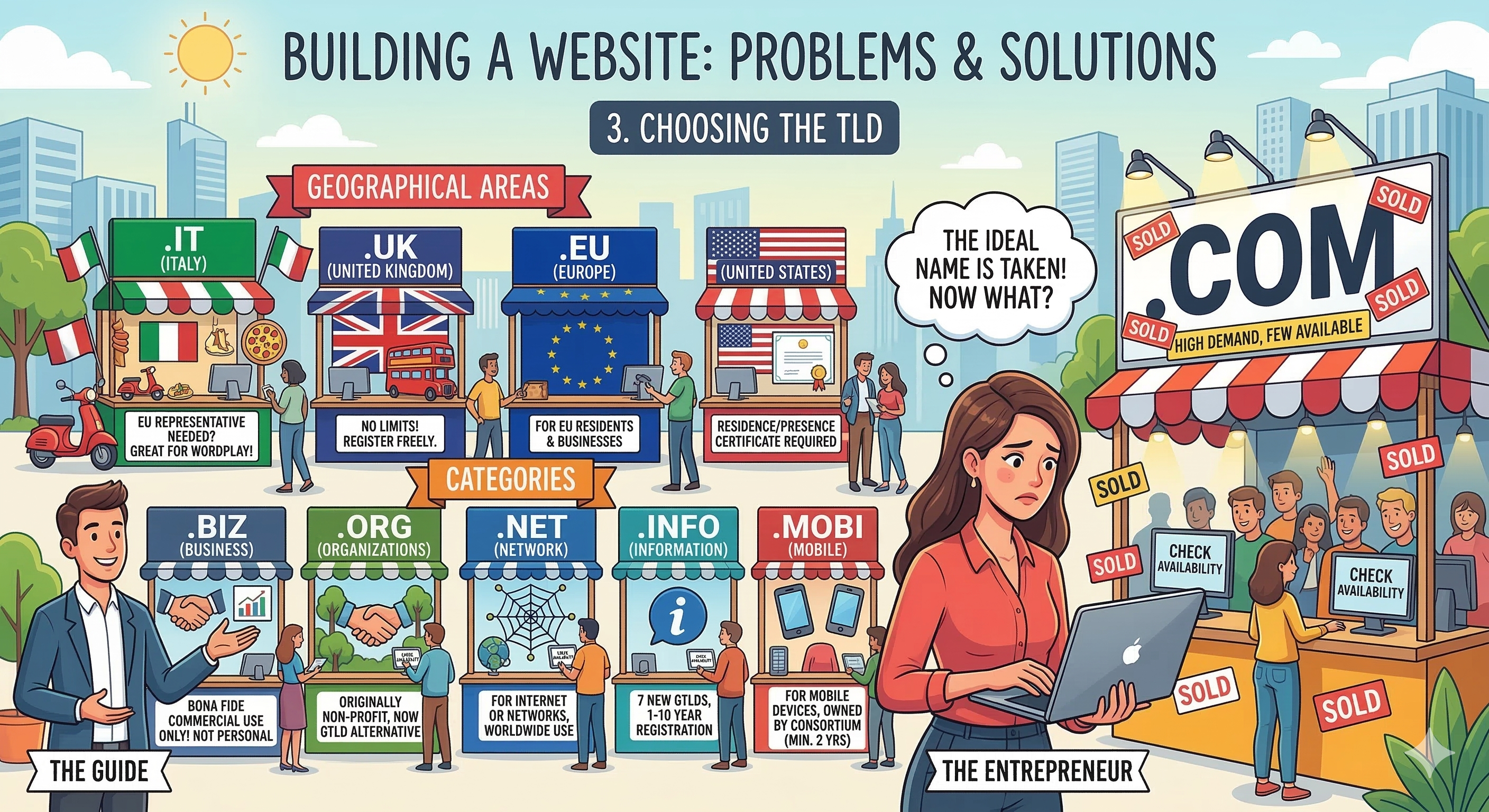
The biggest headache you’ll run into is that the perfect .com name you want is probably taken. This forces you to either change your brand name or settle for a different extension (like .net or .biz). Be careful here: if someone else owns the .com version of your name, your visitors might accidentally go to their site instead of yours!
Sweet Tip: Many smart businesses actually buy both their local geographic domain (like a .co.uk) and the .com version, redirecting one to the other so they never lose traffic.
Behined The Scenes :
You can’t just invent a domain ending. There are official databases managed by specific authorities:
-
Global Domains (like .com, .net, .org): Handled by an independent global group called ICANN (set up in 1999). Anyone in the world can buy these. Country Codes (like .it): Handled by local authorities in that specific country. For example, Italy’s domains are managed by a branch of the CNR in Pisa, which sets the rules and hands out the names.
Breakdown of Countries
If you want to go the geographic route, here are the rules for some of the biggest ones:

-
The .it (Italy): You need to live in the European Union or have a representative there. It’s wildly popular for English wordplay. The .at (Austria): Open to anyone! The only rule is that the name needs at least one letter (no purely numbered sites allowed). Great for making phrases like “look.at”. The .us (United States): This one is surprisingly strict. You actually have to prove you’re a US citizen, a resident, or have a legit business presence there. You also have to buy it in two-year chunks. The .eu (Europe): Open to any person or business officially based in the EU. The .uk (United Kingdom): The wild west in the best way. Anyone in the world can grab one—even minors—and there are no limits on how many you can hoard. The .ru (Russia): Essential if you’re trying to tap into the Russian market. It’s totally open to anyone, anywhere, with zero restrictions.
Category TLDs
If you want a generic, worldwide extension, here is the current landscape:
-
The .com (Commercial): The undisputed heavyweight champion of the internet. It was meant for commerce, but now it’s used for absolutely everything. Having a .com makes your brand look highly established and trustworthy. The catch? Almost all the good, short names are gone.
-
The .net (Network): Originally meant for tech and internet companies, but now it’s a global catch-all. It’s super popular, which means available names are also pretty scarce.
-
The .org (Organizations): Started strictly for non-profits, but today, it’s used by everyone as a solid backup plan if the .com or .net they want is taken.
-
The .info (Information): ICANN created this generic extension specifically to give people more options once the classic .coms started running out. You can lock these in for anywhere from 1 to 10 years at a time.
-
The .biz (Business): Strictly for actual, money-making businesses. You legally aren’t supposed to use this for a personal hobby blog or a complaint site. Just keep in mind: because it’s newer, it doesn’t carry the same “established authority” vibe as a .com.
-
The .mobi (Mobile Devices): Backed by massive tech giants like Google, Microsoft, and Vodafone, this extension is reserved for sites specifically optimized for phones. You have to register it for at least 2 years, and it’s a great way to show your brand is modern and tech-forward.
Leave a Reply